
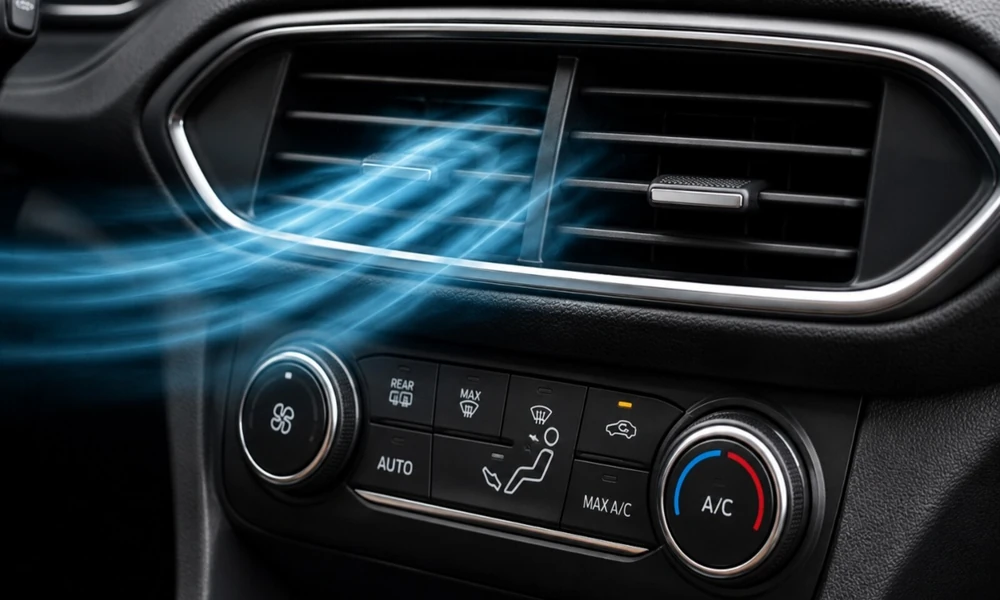
Your AC blows a little less cold on a 95-degree afternoon. Is that a problem, or is it just physics doing its thing? Most drivers shrug and live with it. That shrug can cost them a compressor replacement.
There’s a real and meaningful difference between an AC system that’s working hard and one that’s quietly breaking down. Knowing which situation you’re actually in determines whether you schedule a service appointment this week or end up stranded in a parking lot next month with a fully dead system. This article gives you a clear framework to figure that out.
Why the Central Valley Makes This Harder to Diagnose
If you live somewhere that routinely sees triple-digit summers, your AC never gets a break. Visalia’s summers are described by weather data as hot, arid, and clear, with temperatures across the year typically ranging from 38°F up to 96°F, and occasionally pushing past 103°F. According to WeatherSpark’s climate data for Visalia, average daily high temperatures during summer increase from 88°F to 93°F as the season progresses. That is not a climate where a weakening AC system hides itself well.
The problem is that extreme heat masks early symptoms. A system losing refrigerant slowly might still push marginally cool air at 75°F outside. At 100°F, that same system blows warm air and panics you. The failure was happening for months; the heat just made it obvious.
The Symptom Ladder: How to Read What Your AC Is Actually Telling You
Think of AC symptoms as a ladder. The higher up you are, the more urgent and expensive things tend to get. Here’s how to place yourself on it honestly.
Rung 1: Slightly warmer air than you remember. This alone means very little. Cabin air filters clog, and a dirty filter cuts airflow before it touches the refrigerant circuit. Replace the cabin filter first, always. If air quality improves but temps don’t, move up the ladder.
Rung 2: Noticeably weak airflow even with a clean filter. Now you’re looking at a blower motor issue, a blocked evaporator, or early refrigerant loss. None of those fix themselves.
Rung 3: Warm air even on the max-cold setting. Because the AC circuit runs continuously in a vibrating environment, components and joints are exposed to mechanical stress, pressure fluctuation, and repeated thermal cycling, and over time these conditions increase the likelihood of refrigerant leakage, which is one of the most common causes of automotive air conditioning system failure. If you’re at rung 3, refrigerant loss is the first thing a tech will check.
Rung 4: Intermittent cooling. The AC is ice-cold for ten minutes then goes warm, then recovers. Air conditioning that blows cold then switches to warm, or that works when first turned on but cuts out once the engine reaches normal operating temperature, points to thermal-related component failure rather than a simple recharge issue. Intermittent symptoms are the hardest to diagnose at home and the easiest to misread as “it’s fine now.”
Rung 5: No cooling at all, strange smells, or hissing sounds. You’re past the diagnostic phase. This is a tow-or-drive-straight-to-service situation.
The Four Parts Most Likely to Be the Actual Problem
Warm air almost always traces back to one of four components. Understanding what each one does helps you have a useful conversation with a technician instead of just nodding along.
The compressor. The compressor is the heart of the AC system and the most expensive component. It often fails because the system was run while low on refrigerant, since the refrigerant also carries lubricant for the compressor. Low refrigerant means low lubrication, which leads to premature wear and eventual failure. This is the cascade effect nobody warns you about: ignoring a small refrigerant leak long enough turns a $300 problem into a $1,500 one.
Rubber seals and O-rings. Over time, the rubber seals and O-rings throughout the AC system can become brittle and lose their ability to maintain a tight seal. These seals are found where hoses connect to the compressor, condenser, and evaporator, and as the rubber deteriorates due to heat, vibration, and age, tiny gaps form that allow refrigerant to escape slowly. These are cheap to replace in isolation. Catching them before they starve the compressor is the whole game.
The condenser. The AC condenser sits at the front of the vehicle, near the radiator, and its job is to release heat from the refrigerant into the outside air. Because of its exposed position, it’s vulnerable to damage from road debris, salt, moisture, and small rocks, and over time corrosion or punctures can create tiny leaks in the condenser coils or connections.
The evaporator. The evaporator is located inside the dashboard and is responsible for cooling the air before it enters the cabin. Due to its hidden location, a leak here is difficult to detect and expensive to repair, and if the AC loses effectiveness while the interior smells slightly sweet or chemical-like, the evaporator is often the culprit.
A Quick Diagnosis Decision Matrix
| What You Notice | Most Likely Cause | DIY Fix? | Urgency |
|---|---|---|---|
| Weak airflow, clean filter | Blower motor or evaporator blockage | No | Moderate |
| Warm air on max-cold setting | Refrigerant leak, compressor | No | High |
| Intermittent cooling | Thermal component failure, electrical relay | No | High |
| Musty or sweet smell | Mold on evaporator or refrigerant leak | Partially | Moderate |
| Hissing sound from vents or hood | Refrigerant escaping under pressure | No | Immediate |
What Fixing It Actually Costs (And Why Waiting Makes It Worse)
A lot of drivers delay AC repair because they assume it’ll be minor or they can get through the season. The math rarely supports that plan.
According to a nationwide mechanic survey published by ConsumerAffairs in December 2025, average estimates for recharging the AC in sample vehicles ranged from $430 to $521, while quotes for compressor replacements were far higher, ranging from $1,319 to $2,515 on average. The recharge only makes sense if a tech has already confirmed there’s no active leak. Paying for a recharge on a leaking system just means paying again in three months.
Broader car ownership data reinforces the point about acting early. Bankrate’s 2025 Hidden Costs of Car Ownership Study found that car maintenance and repairs represent the third-largest hidden expense for drivers, averaging $1,384 per year or $115 per month. Deferred maintenance is a key driver of that number.
“Refrigerant leaks are not just a cooling problem. Once the compressor begins running without adequate lubrication, you’re counting down to a full system replacement rather than a simple component fix.” – consensus position among ASE-certified automotive technicians on the priority of early leak detection.
What to Actually Do Right Now
Run through this checklist before you book a service appointment or write the problem off:
- Turn the AC to max-cold and max-fan. Hold your hand at the center vent. If the air is room temperature or warmer after two minutes, refrigerant loss is likely. Book service.
- Listen for any hissing while the system runs. A hiss under the hood or from the dash vents when the AC engages is refrigerant escaping. Do not top off with a store-bought recharge kit; that masks the symptom without fixing the leak.
- Note any smell. Musty means mold on the evaporator, sweet means refrigerant vapor. Both need a tech.
- Check whether the problem is intermittent. If it cools fine in the morning but fails in the afternoon heat, write down exactly when and how, because that pattern helps a technician zero in on a thermal-failure component much faster.
- Replace your cabin air filter if you haven’t in the last 12 months. This one you can do yourself and it costs under $25.
If any of those checks flag a real problem, a dealership-level diagnosis from a team that knows your specific vehicle makes a difference. Drivers in the area trust Honda AC service Visalia at Visalia Honda for OEM-accurate diagnostics and genuine Honda parts, which matters when you’re trying to avoid the compressor cascade failure described above.
The Bottom Line
A car AC that’s struggling is annoying. One that’s actively failing is expensive. The difference between the two comes down to whether you’re reading the symptoms accurately and acting before the refrigerant loss reaches the compressor. Most repairs that turn into $2,000 jobs started as $300 jobs that got ignored through one more summer. Don’t be that story. Get a diagnostic while the fix is still simple.